
This handbook was developed as part of the Erasmus+ project Facing Global Challenges: Environmental and Peace Education in Interreligious Cooperation for Teacher Training. It is designed for teacher educators, lecturers and teachers who want to address ecological responsibility and peace through interreligious learning.
Bringing religious, ethical, and educational perspectives into conversation, the handbook shows how to incorporate topics such as water, climate justice, and environmental protection into teacher education and school practice. It combines conceptual approaches with examples and teaching ideas, drawing on the project partners’ different national and religious contexts.
The materials are intended to support reflection, dialogue and practical engagement. They can be adapted to different educational settings and used as a starting point for developing teaching that connects religious diversity with shared responsibility for a sustainable and peaceful future.
- Materials of the Institutions
- Germany
see the materials of the University of Augsburg - Spain
see the materials of the Barcelona International University of Catalonia - Albania
see the materials of Beder University college Tirana - Malaysia
see the materials of the International Islamic University of Malaysia - Austria
see the materials of the University college of christian churches of teacher education Vienna/Lower Austria
All Materials
Religious Diversity and Interreligious Learning
The content of the project focuses on the topic of water. This focus can be taken up by the
partners in various thematic contexts, for example in connection with drought,
digitalization, clothing, nutrition, or other relevant issues. The template is designed in such a
way that these different approaches can be easily integrated.

Water Ethics from Interreligious Perspective
The central focus of the forum is:
• to understand and address the issue of water as part of Islam, Christianity, Buddhism and Hinduism.
• to understand how religiously significant water is to each religion
• to understand the ethics of using water in each religious ritual

Religion and water
Pedagogical intention: to deepen understanding of the religious meaning of water through knowledge of traditions, direct contact with believers from various religions, and artistic expression as a way of understanding and inner transformation.
The activity moves from conceptual analysis to experiential expression, and from the familiar to the discovery of the other.
The logic of the activity is recalled as: from knowing to understanding, from understanding to living.

Peace, social justice and inter religious dialogue
Pedagogical intention: to connect the learning from the previous activities with social and global reality, to
deepen understanding of the role of religions in building peace and environmental justice, and to close the course
with the design of specific teaching proposals that participants can bring to their classrooms. The activity moves
from understanding to engagement and, finally, to educational action.

Water in everyday life
Pedagogical intention: to place teachers in a direct experience of water as an everyday reality and, at the same time, as a gateway to symbolic interpretation. The activities are designed to bring about a transformation in the way reality is seen and interpreted, while identifying the pedagogical potential of these experiences for the religion classroom.
The central idea introduced is experience as a way of accessing knowledge and pedagogical transformation.

Christian-Islamic Dialogue about environmental ethics
Students first clarify their own religious/ethical or interreligious perspective on water as an environmental ethical issue and then become capable of dialogue on interreligious perspectives in the sense of sustainable development. The students then reflect on their approaches together, develop materials on this topic individually or in groups, or reflect on given materials as a seminar assignment and then present these for further joint reflection.
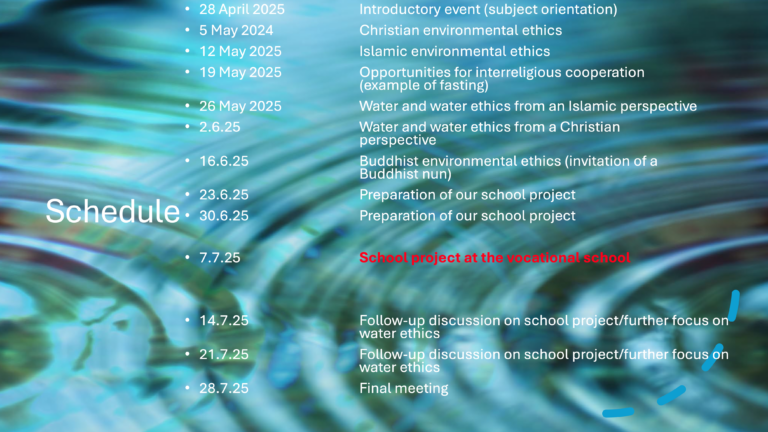
Environmental Learning and Water Ethics in Christian-Islamic Perspective Religious Cooperating Learning
Water is a gift of GOD and how can we distribute it fairly among everyone?
What is justice in my religion?
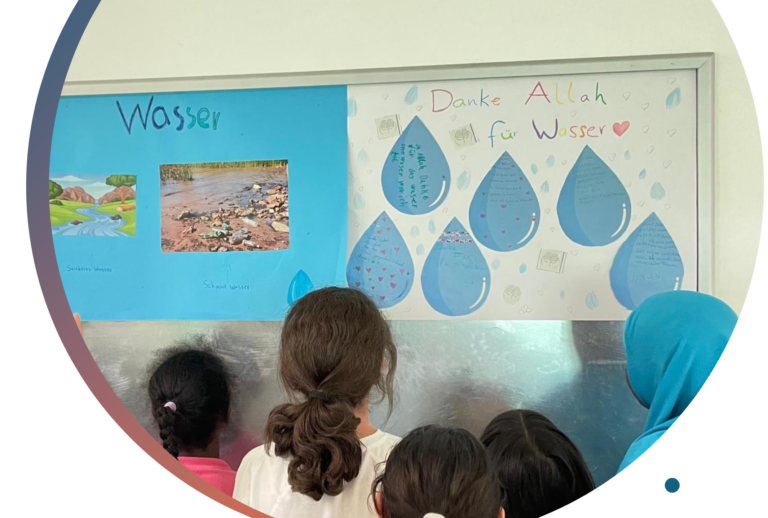
Water as a Sign of God’s Mercy
Theological-Didactical Competence Orientation in School Practice
Water Ethics and Interreligious Environmental Responsibility
This module positions Islamic environmental ethics and interreligious dialogue as practical resources for addressing water-related challenges in Albania. It combines theology, sustainability, and civic engagement, preparing students to act as ethically informed, socially responsible, and dialogically competent citizens.
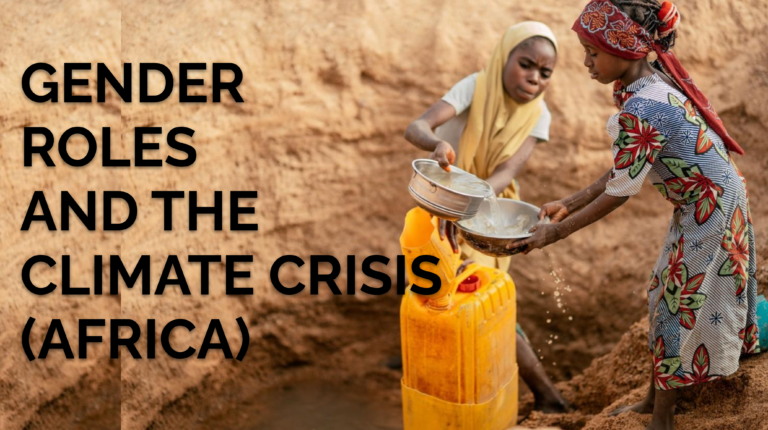
Climate Change Has a Woman’s Face
Students will examine how climate change disproportionately affects women and girls.
A practical country case-study exercise helps them identify existing gender inequalities and explore how climate change can intensify those inequalities .
To reinforce their learning, they will conduct a practical case study analysis of selected countries of their choice.
Zamzam Water
The unit aims to enable students not to consider religious content in isolation, but to reflect on its ethical and societal dimensions.