
Environmental Learning and Water Ethics in Christian-Islamic Perspective Religious Cooperating Learning
University: Augsburg
Abstract
Water is a gift of GOD and how can we distribute it fairly among everyone?
What is justice in my religion?
General Information
| Teaching unit | Details |
|---|---|
| Title of the course | Christian- Islamic dialogue about environmental ethics |
| Title of the session (teaching unit at the university) ot thematic focus | Water as a gift, resources and responsibilities-ecological, ethical and interreligious perspectives |
| Subject / degree program | Theology with a focus on religious education |
| Classification within the module | Part of the module area Interreligious Education/Enviromental Ethics/ Education for Sustainable Development (ESD) within teacher education and religious education studies |
| Partner organization (intemal or extemal cooperation partner) | Fos/Bos in Augsburg (vocational school context) |
| Target group | University students of religious education and students oft he certificate for interreligious mediation (CIM); indirectly pupils in secondary education |
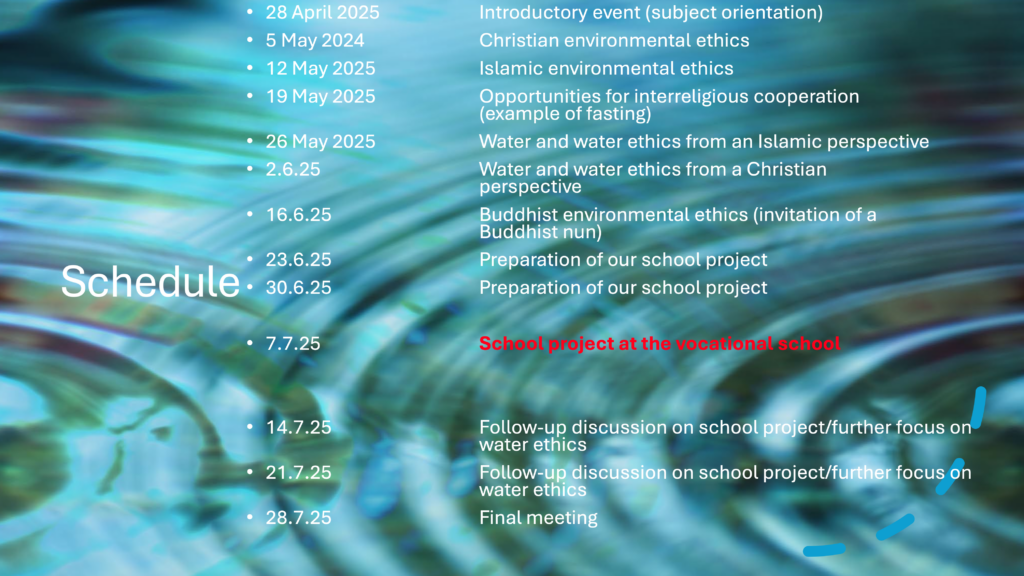
| Time frame | Summer semester (12 weeks, one session per week) |
Objectives and classification
| Aspect | Implementation in context |
|---|---|
| Content focus ( clarification of one’s own religious/ ethical views) | Explanation oft he own religious or confessional backgrpund; Examination of water as a vital resource, religious gift and ethical responsibility through theological, ecological, technological, and political case studies ( e.g. drinking water treatment, lithium extraction, sustainable agriculture) |
| Basic didactic idea (How can a connection to one’s own life be established?) | Strong connection to students’ lifeworlds through everyday experience with water (drinking water, consumption, fasting practices) and current global challenges (Methodology: Group discussion and presentation) |
| Connection to religious sustainable development | Comparative engagement with Christian and Islamic perspectives on water ( creation, purity, avoidance of waste, (global) responsibility, moderation) based on biblical texts, Qur’ anic verses, and Hadiths Water as a key issue of global justice, biodiversity and resource protection; critical reflection on technology, economy, and politics in the sense of Education for Sustainabile Development (ESD) |
| Interreligious connectivity (How can an interreligious perspective be opened up?) -> Terms, questions | Water scarcity, sustainability, stewardship of creation, purity, avoidance ofwaste, gobal responsibility |
| Outcome of the session (questions for interreligious exchange) | Development of shared ethical questions for interreligious dialogue, e.g.: How much water consumption is justifiable? Who owns water? How can religious traditions motivate sustainable actions? |
Competencies and learning objectives
| Area of competence | Learning objectives |
|---|---|
| Technical competence (water & sustainability) | Students explain key aspects of water as a resource (significance, lines of conflict, protection perspectives) and classify these in terms of sustainability issues. |
| Religious self-clarification | Students identify and explain key interpretations, values, and norms of their own religious/ethical tradition with regard to water (e.g., purity, ritual, responsibility,justice, reference to creation). |
| Didactic and pedagogical competence | Students outline how the topic of water and water ethics can be addressed in educational settings (school/university) in a competenceoriented and open-minded manner. |
| Interreligious competence | Students inform themselves about the interpretations of other religions and formulate respectful questions about other perspectives. |
| Transfer competence | Students apply the results to specific contexts (campus, school, community, everyday life, local waterways, consumption) and develop teaching and leaming materials (with reference to educational plans/curricula). |