
Different faiths – common action
Interreligious Education for Sustainable Development (irESD) is a central outcome of our Erasmus+ project, Facing Global Challenges: Environmental and Peace Education in Interreligious Cooperation for Religious Teacher Training.
Our approach
The approach connects religious and interreligious learning with environmental responsibility and peace education. It brings different religious perspectives into cooperation, enabling teachers and learners to explore shared ethical concerns and develop practical responses to sustainability challenges.
Under the guiding principle “Different faiths – common action”, participants work together while respecting their distinct religious identities.
The programme supports teacher education and classroom practice. It aims to strengthen empathy, solidarity and the confidence to take responsibility together, connecting reflection on global challenges with action in local contexts.Related to the Erasmus+Project water and water ethics provide a particular focus, linking environmental questions with justice, access to resources and peaceful coexistence.
Publications on irESD
Publications produced as part of the Erasmus+ project Facing Global Challenges: Environmental and Peace Education in Interreligious Cooperation for Teacher Training.
Naurath, Elisabeth (2026): Connectedness as the spiritual basis of religious education for sustainable development. In: Manfred L. Pirner, Elisabeth Naurath, Johannes Lähnemann, Werner Haußmann (Hg.): Education for sustainable development – spiritual dimensions. Erlangen: FAU University Press (FAU Studien aus der Philosophischen Fakultät ; 35) (Veröffentlichungen der Forschungsstelle für Öffentliche Religionspädagogik ; 1), S. 105-121.
PDF | BibTeX | RIS | URL
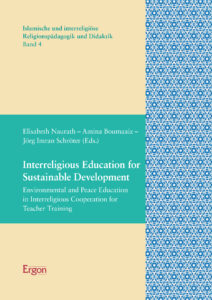
Mohamed, Najma; Naurath, Elisabeth: Ecological pedagogies: education for climate and ecological justice. In: Farhana Mayer, Séverine Deneulin, Philipp Öhlmann, Juliane Stork (Hg.): On the care and balance of our common home: Christian-Muslim dialogues. Göttingen: Vandenhoeck & Ruprecht (Studies on Religious Social Practice) 2026
Naurath, Elisabeth (2026): Facing global challenges: Interreligiöse Bildung für nachhaltige Entwicklung (irBNE). In: Markus Vogt, Elisabeth Naurath, Maximilian Gigl (Hg.): Verlieren wir die Zukunft? Auf der Suche nach Hoffnung im Spannungsfeld von Ökologie und Religion. Freiburg: Herder (Kirche in Zeiten der Veränderung ; 23), S. 219-233.
BibTeX | RIS
Naurath, Elisabeth (2026): Umweltbildung als Friedensbildung in interreligöser Perspektive. In: Stefan Altmeyer, Bernhard Grümme, Jasmine Hieronymi-Suhner, Elisabeth Naurath, Bernd Schröder, Lena Tacke (Hg.): Frieden. Göttingen: Vandenhoeck & Ruprecht (Jahrbuch der Religionspädagogik ; 42), S. 288-297. DOI: 10.13109/9783666700279.288
BibTeX | RIS | DOI
Naurath, Elisabeth (2025): Klima und Frieden: Verantwortung und Potential religiöser und interreligiöser Bildung. In: Uta Heil, Annette Schellenberg-Lagler (Hg.): Krieg und Frieden. Göttingen: Brill / V&R unipress (Wiener Jahrbuch für Theologie ; 15/2025), S. 233-244. DOI: 10.14220/9783737018517.233
PDF | BibTeX | RIS | DOI
Gehenzig, Melanie; Naurath, Elisabeth; Noormann, Harry; Wobser, Florian (2025): Kompetenzorientierung. In: OR Orientierungsrahmen Globale Entwicklung – Bildung für nachhaltige Entwicklung in der gymnasialen Oberstufe. Bonn: Engagement Global, S. 320-325.
BibTeX | RIS | URL
Inou, Sylvia/Jakob, Jennifer (2025): Fragen, die die Welt verändern: Kinderphilosophische Zugänge im Kontext von Bildung für nachhaltige Entwicklung. In: HAUPtsache. Zeitschrift für pädagogische Praxis/Schule & Beratung. (2025), 42-44
From Theory to Practice
Karlsruhe University of Education · 12 May 2026
Interreligious Education for Sustainable Development in Practice
How can interreligious education for sustainable development become part of everyday teaching? A conference at Karlsruhe University of Education brought together teachers, researchers and representatives of Jewish, Christian and Muslim traditions to explore this question.
Organised within the Erasmus+ project Facing Global Challenges, the event connected theological reflection with practical approaches for religious education. Contributions addressed the climate crisis, hope and responsibility, alongside teaching models based on interreligious encounters and shared action.
Examples included Christian–Muslim team teaching on water, pilgrimage as an opportunity for ecological and spiritual learning, and approaches to addressing young people’s concerns about the future. A gallery walk presented resources for schools and teacher education.
The conference highlighted the need for accessible teaching materials and continued cooperation between universities, schools and religious communities. It demonstrated how different religious perspectives can contribute to shared environmental responsibility through concrete educational practice.
PDF deutscher Bericht mit Logos und barrierefrei
Teaching Resources
Explore our digital handbook for theoretical introductions and practical resources supporting interreligious education for sustainable development in schools and teacher education.